St. Louis, MO · Electrical Bus Duct Buyers
Sell Bus Duct in St. Louis, MO
St. Louis facility and construction teams call us when equipment is coming out and nobody wants to coordinate an electrician, a rigger and a hauler around one outage window. We are all three, and we pay you for the equipment on top of it instead of charging you to haul it away.
Same-day written offer
Get a Written Offer
Send the asset list, or just describe what is in the room. We come back the same business day with a written, itemized offer.
Faster: call 954-740-1983
Email an asset list to electricalequipmentbuyers@gmail.com
Mon–Sat, 7am–7pm CT. We never resell your contact information.
- Location
- St. Louis, MO
- Desk
- Electrical Bus Duct Buyers
- Ratings
- 225 A – 5,000 A, copper and aluminum b
- Offer
- Same business day
- Payment
- Before load-out
- Phone
- 954-740-1983
This city
Bus Duct buyers serving St. Louis
Missouri gives us two metros pulling in opposite directions across the state, and I-70 between them is a route our trucks already run. St. Louis brings automotive assembly, aerospace, the chemical corridor along the river and a stock of older industrial buildings whose electrical scopes come out during conversion. Kansas City brings distribution, food processing and rail. In between, the lead and zinc operations in the southeast and the Springfield-area manufacturers run heavy switchgear. Ameren Missouri and Evergy both retire distribution equipment continuously, and the river barge terminals at St. Louis and Kansas City make Missouri a practical consolidation point for lots coming out of neighbouring states. For St. Louis specifically that density helps: crews already move through St. Louis, Kansas City, Springfield and Columbia, so mobilization is a scheduling question rather than a cost problem.
If the St. Louis equipment is still carrying load we phase it — dead sections and spares first, distribution as circuits are released, the main line-up on the final clearance. The phasing is written into the offer so nobody improvises in an energized room at two in the morning.
| Item | Detail |
|---|---|
| Ratings | 225 A – 5,000 A, copper and aluminum bus |
| Scope | Feeder and plug-in busway, indoor and outdoor |
| Nameplates | Square D I-Line, General Electric Spectra and Armor-Clad, Eaton and Cutler-Hammer Pow-R-Way, Siemens Sentron, Westinghouse, Federal Pacific, ITE, Bulldog |
| Condition | Working, retired, water-damaged or already dismantled |
| Minimum | One section, one unit, or a whole plant lot |
Equipment
What we take out of St. Louis sites
Plug-in busway runs
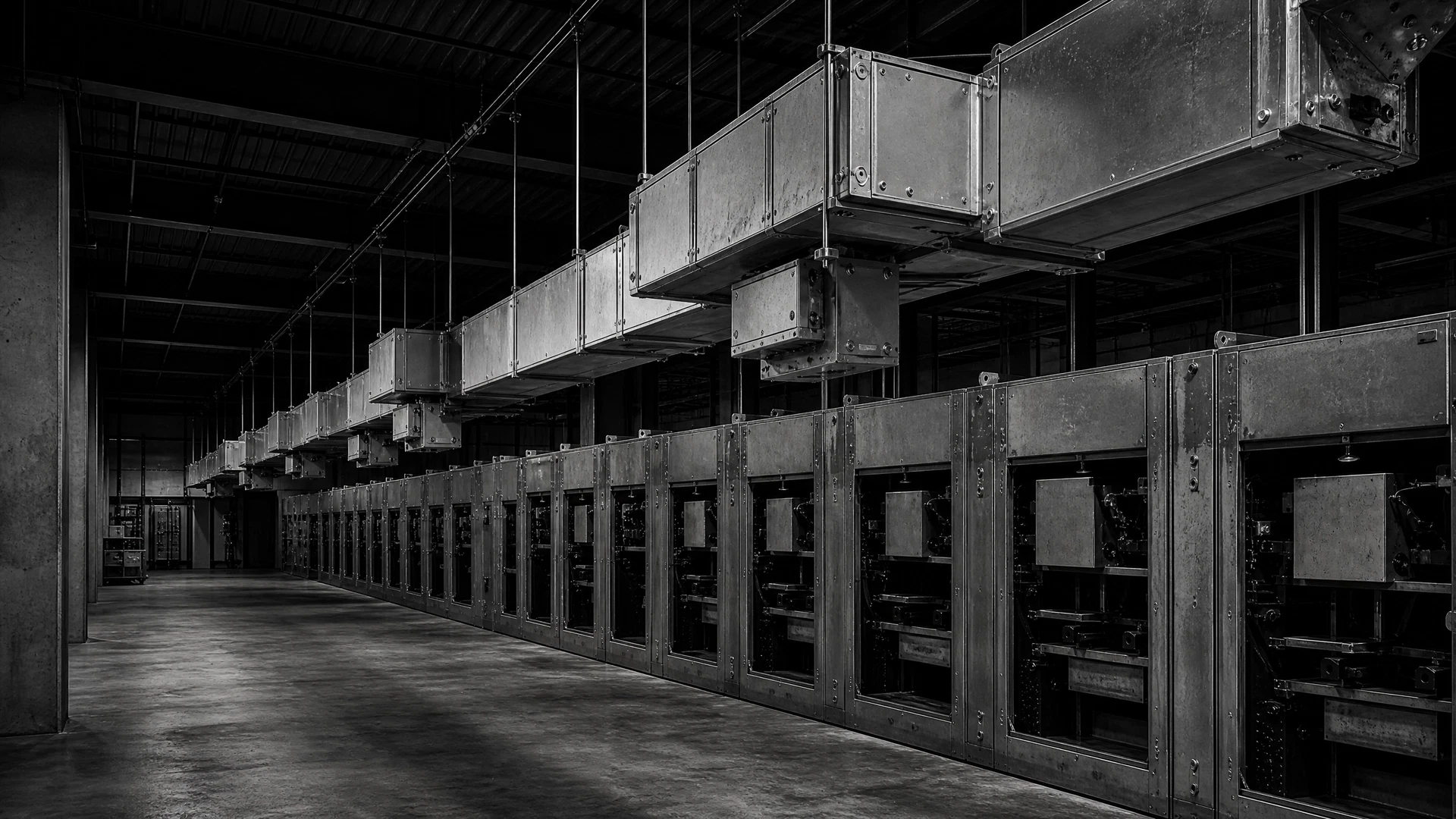
Horizontal plug-in runs over production floors, with or without their plugs, in straight lengths plus the elbows, tees, offsets and hangers that came with them. Straight sections in common systems resell as replacement lengths; odd fittings are often the hardest items for a plant to source, which makes them disproportionately valuable.
Feeder busway and risers
Feeder runs between service equipment and distribution, and vertical risers in commercial buildings with their tap boxes and floor fittings. Riser removal is a stairwell-and-elevator problem as much as an electrical one, and we plan it on the survey.
Missouri specifics
Missouri gives us two metros pulling in opposite directions across the state, and I-70 between them is a route our trucks already run. St. Louis brings automotive assembly, aerospace, the chemical corridor along the river and a stock of older industrial buildings whose electrical scopes come out during conversion. Kansas City brings distribution, food processing and rail. In between, the lead and zinc operations in the southeast and the Springfield-area manufacturers run heavy switchgear. Ameren Missouri and Evergy both retire distribution equipment continuously, and the river barge terminals at St. Louis and Kansas City make Missouri a practical consolidation point for lots coming out of neighbouring states.
Nearby
Nearby and related
Nearby Missouri coverage — crews serving St. Louis also run to:
Common questions
St. Louis questions
Do you buy equipment that is still energized and in service?
Yes, and most of what we buy is. We quote it now and remove it on your cutover date. Telling us at the quote stage which St. Louis assets are still live lets us build the phasing and the clearance coordination into the schedule from the beginning.
Our electrical room is in a basement with a tight door. Is that a problem?
It is routine. Switchgear sections, transformers and gensets frequently have to be cut down or partially disassembled to clear a door width, an elevator limit or a stair turn. The access survey at your St. Louis site establishes the path before we commit to a date, and that cost is already inside the offer.
Will you take the equipment we cannot sell along with the good items?
Yes, and this is usually why sellers choose us. Cherry-picking leaves you holding the leftovers of the leftovers. We price the St. Louis lot as a whole — good gear, obsolete gear and the scrap fraction together — so the electrical room ends up genuinely empty.
Do you provide documentation for surplus property or audit records?
Yes. Itemized purchase agreements, weight tickets, bills of lading, oil disposal manifests and recycling documentation are standard on St. Louis purchases. Public agencies and audited facilities get the paperwork their process requires without having to ask twice.
Do you actually buy electrical equipment in St. Louis, or just broker it?
We buy it. Midwest Electrical Buyers is the purchaser of record — we fund the purchase, send our own crews to St. Louis to disconnect and load, and take title when the equipment leaves your dock. There is no third party behind us waiting to approve the price.
Bus Duct in St. Louis?
One call, one written offer, one crew. Payment before the trailer leaves.